Top Thermal Roll Printers for Your Business Needs?
In today's fast-paced business world, efficiency is key. One essential tool that many companies rely on is the Thermal Roll Printer. These printers play a critical role in various industries, from retail to logistics. They provide quick and high-quality printing solutions that can significantly enhance productivity.
However, choosing the right Thermal Roll Printer can be daunting. With countless options available, each model presents its unique benefits and drawbacks. Companies must evaluate their specific needs before making a decision. The right choice can lead to smoother operations, while the wrong one might result in frustration and wasted resources.
It's essential to reflect on what features matter most. Speed, print quality, and durability are crucial, but also consider connectivity options and maintenance needs. Investing time in research will yield better results in the long run. A thoughtful approach can transform your printing experience and elevate your business's overall efficiency.
Key Features to Consider in Thermal Roll Printers
When choosing a thermal roll printer, several key features play a crucial role in meeting your business needs. Print speed is one important factor. A good printer should deliver fast output, generally around 200-300 mm/sec, ensuring efficiency in busy environments. A printer's resolution also matters; higher DPI (dots per inch) results in clearer, sharper images. Typical resolutions are 203 DPI, but some devices offer 300 DPI for detailed graphics.
Connectivity options can impact your workflow. Many modern printers support USB, Ethernet, and even Bluetooth. This flexibility allows for seamless integration into existing systems. Moreover, ease of use is significant. User-friendly interfaces reduce the learning curve. Look for printers with intuitive controls and clear display screens to simplify operations.
Tips: Assess the volume of printing your business requires. If you expect high usage, choose a model designed for durability. Maintenance is another consideration; regular cleaning and care can prolong the printer's lifespan.
Another essential feature is media compatibility. Most printers handle various roll sizes, but some may limit you to specific widths. Consider your future needs as well. A printer that meets today’s requirements may not suffice in a few months. Aim for a device that can adapt as your business evolves.
Top Thermal Roll Printers for Your Business Needs
This chart presents crucial specifications of top thermal roll printers essential for business needs. The data includes print speed, paper width, connectivity options, max resolution, and monthly duty cycle to help you choose the right printer for your requirements.
Types of Thermal Roll Printers Available for Businesses
Thermal roll printers are essential tools for many businesses. They offer fast, reliable, and cost-effective printing solutions. Different types cater to various needs. Understanding these types can help businesses choose the right printer for their operations.
Direct thermal printers use heat-sensitive paper. They are ideal for shipping labels and receipts. A report by Grand View Research states that the direct thermal printing segment is expected to grow by 5% annually from 2021 to 2028. This growth indicates increasing adoption in retail and logistics sectors. On the other hand, thermal transfer printers utilize ribbons for printing. They offer better durability but can incur higher costs.
**Tip:** Consider your printing volume. If you print large quantities regularly, choose a high-speed model. Additionally, look for options with easy loading features. This can save you time and reduce frustration during busy hours.
Mobile thermal printers have gained popularity. They provide convenience for on-the-go printing needs, perfect for delivery services or outdoor events. However, their battery life can sometimes be a limitation. Always check the specifications before purchasing.
**Tip:** Evaluate the compatibility of the printer with your existing software. This ensures a smooth workflow and minimizes downtime. A mismatch can lead to additional costs and wasted resources. Remember, not every printer fits every scenario.
Top Thermal Roll Printers for Your Business Needs
| Printer Type |
Print Speed (mm/sec) |
Max Print Width (mm) |
Resolution (DPI) |
Connectivity Options |
Ideal Use Case |
| Direct Thermal Printer |
150 |
80 |
203 |
USB, Serial |
Retail Labels |
| Thermal Transfer Printer |
120 |
100 |
300 |
USB, Ethernet, Wi-Fi |
Shipping Labels |
| Mobile Thermal Printer |
75 |
50 |
200 |
Bluetooth |
On-the-Go Receipts |
| Industrial Thermal Printer |
300 |
150 |
600 |
USB, Serial, Ethernet |
High-Volume Labeling |
Top Brands of Thermal Roll Printers and Their Offerings
When selecting thermal roll printers for business needs, it’s essential to consider various offerings from reputable brands. Many options provide robust features tailored for different applications, such as
shipping labels, receipts, and barcode printing. Some models boast impressive print speeds. Others focus on compact designs that save space in a busy work environment.
Durability is another crucial factor. Many printers are built to withstand high-volume usage. However, not all printers perform equally under stress. It is important to check user reviews. Some models may face frequent
paper jams or connectivity issues. Each brand often has unique strengths, but it's vital to assess your specific printing volume and requirements.
Flexibility in media compatibility is an attractive feature. Certain printers can handle multiple roll sizes and types. This can significantly enhance efficiency, but not every option excels in this area. Some may be limited in media choices, causing frustration when switching tasks.
Ensure you pick a printer that fits your varied needs without sacrificing quality.
How to Choose the Right Thermal Roll Printer for Your Needs
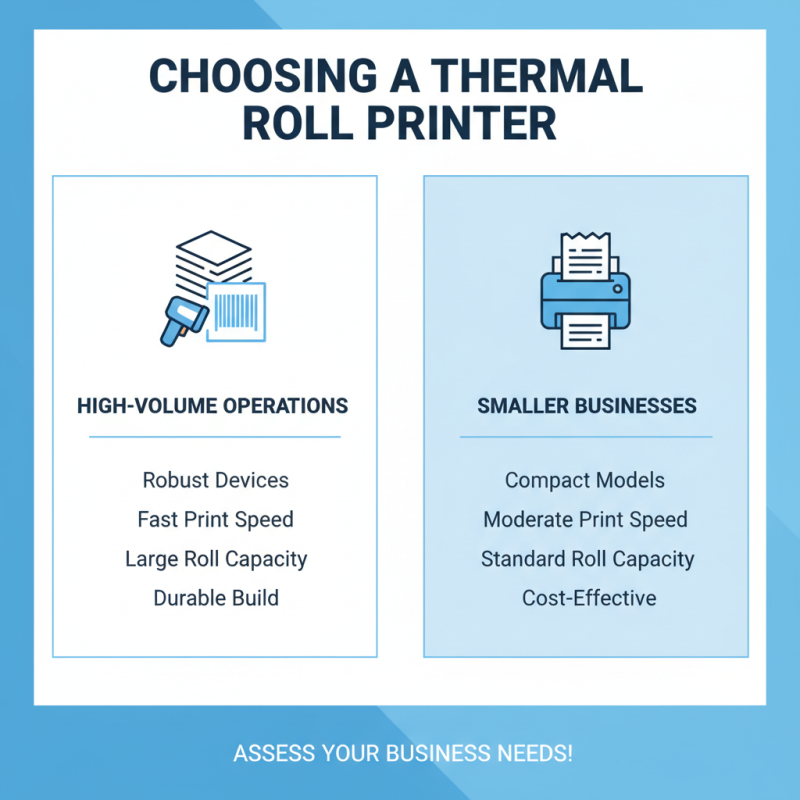
Choosing the right thermal roll printer can be daunting. Start by assessing your business needs. For instance, consider the volume of printing. High-volume operations require robust devices. Smaller businesses may manage well with less advanced models.
Next, think about the types of labels or receipts you will print. Some printers specialize in particular formats. For example, one might print shipping labels well but struggle with smaller ones. Additionally, evaluate connectivity options. USB, Bluetooth, and Wi-Fi are all choices. Make sure the printer connects easily to your existing systems.
Lastly, weigh the cost against features. While cheaper printers are tempting, they may lack durability. Maintenance costs can add up over time. Reflect on your long-term needs versus short-term savings. A thoughtful selection process is crucial. Take your time to research carefully.
Maintenance Tips for Optimal Performance of Thermal Roll Printers
Thermal roll printers are vital for various business applications. To ensure these machines work efficiently, regular maintenance is key. A simple cleaning routine can significantly enhance performance.
Wipe the print head gently with isopropyl alcohol. This removes residue that can cause print quality issues. A clogged head may lead to faded prints or streaks.
Next, check the rollers and gears. Dust and debris can accumulate, leading to jams. Use a soft brush or cloth to keep these parts clean. Lubricate moving parts lightly to prevent wear and tear. Remember, excessive lubrication can attract dirt. It's a balancing act that requires attention.
Lastly, monitor ink and supplies. Running low on thermal rolls may disrupt workflows. Ensure you have backups on hand. Regularly replacing rolls will help maintain print clarity. Ignoring small issues can lead to bigger problems later. Be proactive in your maintenance routine. A few minutes spent on care can save hours of frustration.